New York, Greenwich Village. Early April, early evening. Susan sat in her apartment above a used bookstore — the one she’d rented for three years, overpriced but she loved the smell that drifted up from downstairs: old paper, wood floors, and occasionally coffee. Across from her sat Marcus, her boyfriend of three years. He was holding a cup of coffee that had gone cold, his laptop open to a jewelry brand’s website.
“You said you didn’t want to go to a store?” Marcus asked.
Susan was curled on the couch, knees tucked against her chest. Her own laptop screen showed a Pinterest board she’d been building for three months — fifty-seven images of rings. Vintage silver bands from antique shops. Custom pieces from independent designers. Not a single one in a Tiffany blue box.
“I don’t,” she said. “I went twice. First time on 47th Street — an old man looked at me over the counter and asked my budget. I said I was still looking. He handed me a catalog and told me to flip through it myself. Second time in Brooklyn — the saleswoman kept asking me ‘what style does your boyfriend like.’ I said, ‘He’s not the one wearing it.’ She paused, then launched into ‘classic styles never go wrong.’ Not once did anyone ask me what I actually liked.”
Marcus was quiet for a moment. He’d known Susan for four years. She was the kind of person who read twenty reviews before buying a lamp. Her tolerance for being sold to was practically zero.
“So what did you find online?” He turned his laptop around.
Susan sat up and pulled the machine toward her. She clicked open a page — a moss agate ring. The stone’s green veins spread like a miniature forest trapped in resin, every one completely different. She traced the screen with her fingertip, zooming in on the fine white lines threading through the dark green base.
“This is the ‘Nature-Inspired’ collection,” she said. “Every stone is unique. You can’t walk into a store and say ‘I want that one’ — because that one is that one. There won’t be another identical one.”
Marcus leaned in. He didn’t say anything.
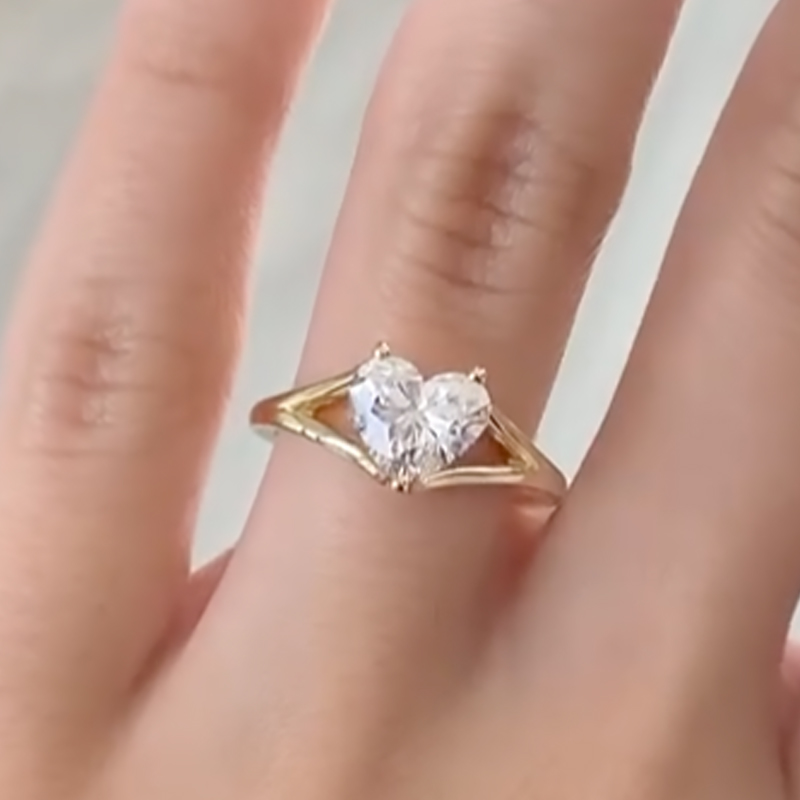
“And this one.” She clicked again. A heart-cut moissanite set in a leaf-shaped band. She scrolled down — the product description read: “Inspired by the contours of forests and the veins of leaves, this ring places the fragility of nature alongside the permanence of a gemstone. Each ‘leaf’ is hand-shaped, not cast from a mold.”
She turned the laptop back toward him. Marcus looked at the screen for a long time.
“How much?” he asked.
“Bottom of the page. Starts at $149.”
“One forty-nine?”
“Moissanite.”
Marcus put down his coffee cup. The clink against the wooden table was loud in the quiet room.
“You said ‘moissanite,'” he said. “That’s the one that’s — “
“That’s the one.” Susan knew what he was going to say — “similar to diamond but cheaper” — but she didn’t finish the sentence for him. She was waiting for him to say it differently.
Marcus paused. “That’s the one they found in a meteor crater?”
Susan blinked. She hadn’t expected that. She’d read that detail somewhere in a corner of the internet a month ago, but she’d never mentioned it to him.
“How do you know that?”
“You left your phone in the bathroom last month. I saw an open page. You’d searched ‘moissanite discovery history.'”
Susan felt heat creep up her neck. Not anger. Something more complicated — being seen in the middle of something she hadn’t decided to share. She reached over and closed the laptop.
“How long did you look?”
“Maybe… until the part about 1893. Henri Moissan. Arizona. The crater.” He counted on his fingers. “Then I heard you coming out of the bathroom.”
Susan looked at his fingers. His nails were cut short, and there was a thin scab on the side of his right index finger — a cut she didn’t know where he’d gotten.
“So you know what it is,” she said.
“I know it’s a rock from outer space,” Marcus said. “That’s more interesting than ‘a diamond is forever.'”
From “How Much Did You Spend” to “What Story Does Your Ring Tell”
Susan didn’t sleep that night. She lay in bed, staring at the crack in the ceiling — a thin line that ran from the light fixture all the way to the corner of the room, like a folded map.
She kept thinking about what Marcus had said. More interesting than “a diamond is forever.”
The next morning, she made tea, sat back on the couch, and reopened the leaf ring page. This time she didn’t look at the ring itself. She scrolled to the “About Us” section at the bottom.
“Today’s consumers want rings that reflect their personal style while remaining affordable. Our designs combine romantic symbolism with natural elements, offering a meaningful choice without the cost of traditional diamond jewelry.”
She screenshot that.
Then she pulled up an industry trends article she’d bookmarked. It included one statistic: in 2026, 61% of newlywed American couples chose lab-grown diamonds or alternative stones for their engagement rings — a 239% increase from 2020. And at the bottom of the article, a line in bold: “It’s not because they’re cheaper. It’s because ‘I don’t want to walk into a store, swipe a card in twenty minutes, and tell my friends my fiancé spent forty minutes choosing it.’ Forty minutes isn’t a story — it’s a sales pitch.”
She screenshot that too.
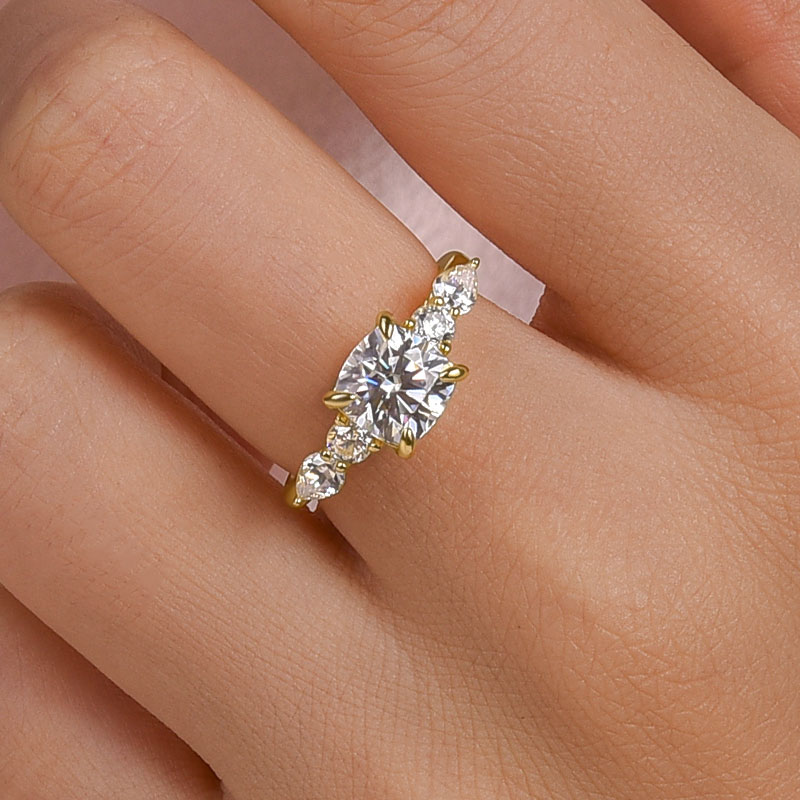
She created a new folder. Named it “Options.” Started filling it — the leaf ring, the moss agate, the trilogy ring description, the history of moissanite, the 61% statistic, and a photo of a book page about Prince Harry’s three-stone ring for Meghan Markle — three stones representing past, present, and future.
Three weeks later, the folder had forty-two screenshots.
She hadn’t mentioned any specific ring to Marcus. She was waiting until she knew which one she wanted.
The Man Who Spent $300 and Four Months
One night, scrolling Reddit, Susan found an old post from 2016. The poster was a guy named Paul Jarvis from Missouri. He’d documented, in painstaking detail, how he’d spent months making an engagement ring by hand.
Four nights a week. Two hours a night. In his garage. He’d started with a bar of silver — no molds, no pre-made settings — and with basic tools — files, sandpaper, a soldering torch — had shaped it into a six-prong setting. Then he’d had a jeweler set a half-carat moissanite.
Total cost: $300.
He wrote: “My girlfriend and I barely saw each other during this time because she was in night school. This was emotionally and physically exhausting, but I knew I wanted to finish it before the new year. We’d never even discussed a ring — we just knew we wanted to get married. To me, this ring represents one of the hardest periods we went through as a couple — and we made it through, completely intact.”
The post had over a thousand comments. Someone asked why he didn’t just buy a ready-made ring. Paul replied: “Because I wanted her to know how long I waited.”
Susan read it three times.
She’d never made a piece of jewelry in her life. But in that moment, she understood exactly why Paul had spent $300 and four months on something a credit card could have solved in twenty minutes. It was a promise that didn’t need to be spoken — longer than “I’m serious,” harder to fake than “I love you.”
She screenshot the post. Not the whole thing — just the last line: “To me, this ring represents one of the hardest periods we went through as a couple.”
She saved it to the “Options” folder.
Later, when she showed Marcus the screenshot, he asked something interesting: “Is four months worth more than forty minutes?”
Susan thought about it. “It’s not about the time. It’s that he was willing to spend it.”
Marcus didn’t ask again.
Leaves, Stars, and Three Stones
Susan started searching with purpose.
She learned moissanite isn’t just white. It comes in blue, green, champagne, pink. Some are treated — heat or coatings change their color. Some are untreated, retaining the natural hue they developed during growth.
She learned the trilogy ring’s meaning — three stones for past, present, and future love. Prince Harry’s engagement ring for Meghan Markle in 2017 was a trilogy design — the center stone from Botswana, the side stones from Princess Diana’s collection. It had been copied countless times, but the original carried one man’s mother, a cross-continental love story, and a specific image in his mind when he made the choice.
She learned the leaf ring’s process — each “leaf” hand-shaped, not molded, so every ring was microscopically different. The line on the page — “placing the fragility of nature alongside the permanence of a gemstone” — she read that over and over. It felt like it wasn’t just about a ring.
She found a profile of Eclara Jewelry’s founder: “We’re seeing more couples look for rings that genuinely feel personal — not picking from the same traditional styles everyone else has. This isn’t a consumer decision. It’s a narrative decision.”
Narrative decision. Susan wrote that in her notebook.
She started organizing everything she’d collected. Moissanite’s history. Paul’s story. The trilogy meaning. The leaf ring’s craftsmanship. She put it in a document with headings, like preparing for a class presentation she’d never actually give.
The Answer Found in a Crater
The ring Susan eventually chose wasn’t white. It wasn’t the “diamond-like” color. It was blue — deep, dark, nearly black in certain light. Only under direct sunlight did it reveal a cold, gray-tinted blue.
She found it on a design award page. The ring was inspired by Pride and Prejudice — the love story of Darcy and Elizabeth Bennet. The designer had used untreated moissanite’s deep luster to capture “the tension between restrained emotion and eventual unfolding.”
The description was restrained — almost academic. Susan read it once, then copied the URL and emailed it to herself three times, just in case.
The stone was untreated Prussian blue moissanite — no dyes, no coatings. The metal was unplated 925 sterling silver, finished with a fine textured engraving. Minimalist, but with visible hand-tool marks. The inside of the band could be engraved — fifteen characters max.
Susan spent an entire day on the engraving line.
She thought about “forever” — too cliché. “Yours” — too vague. “3.14” — the date of their first date — but what if she cringed at it later?
Then she remembered what Marcus had said: “More interesting than ‘a diamond is forever.’ She wanted to engrave “interesting.” But that’s ten characters — English, too long. She thought for another ten minutes, deleted everything she’d typed, and entered three words:
“Not pretending.”
Fifteen characters. Exactly.
She paid. $168. Including engraving.
The Afternoon the Ring Arrived
The ring arrived on a Wednesday. Susan left work early and saw the gray plastic-wrapped package on the counter in her building lobby. She carried it upstairs, fingers tingling slightly.
She sat at the kitchen table to open it. Her coffee cup from the morning was still there, a dried brown ring at the bottom. She thought about washing it first, but couldn’t wait.
Inside the box was a small dark gray velvet pouch, tied with a thin cord. She untied it and tipped the ring into her palm.
Silver. Unplated, warm, matte — not reflective. The band surface had fine textured engraving that felt slightly rough against her fingertip, like something sanded down by hand. She turned it over. The inside of the band read, in clear letters, “Not pretending.” The letters had slight indentations at the bottom — hand-engraved, not laser.
She slid it onto her finger.
Perfect fit — she’d measured three times with a ring sizer, gotten the same number each time, and screenshotted it to the seller. As the ring passed her knuckle, she realized she was holding her breath.
She raised her hand to the kitchen window.
Outside, a gray April afternoon — not strong light, but clear and clean. The moissanite caught it and revealed a deep Prussian blue — not bright, not pale, more like the edge of deep ocean: gray-blue, ink-blue, with a silver undertone. She rotated her finger. The stone shifted from blue to deep violet to an indeterminate gray. Not the jumping, sparkling kind of flash. Something quieter, slower, always changing.
She sat there for a long time.
Then she sent Marcus a photo. Caption: “It’s here.”
He replied: “Beautiful.”
Ten seconds later: “Just like I thought it would be.”
Susan didn’t know if he meant the ring itself, or the way it looked on her hand, or something else. She didn’t ask. Some things don’t need to be asked.
The Question Nobody Asked at the Wedding
Five months later, they got married in a community garden in Brooklyn. Small — twenty-three people, surrounded by brick walls covered in ivy. No officiant — a friend who worked in social services stood in. The bouquet was cut from a neighbor’s rose bushes — the neighbor had been growing them for twenty years and when Susan mentioned the wedding, she said, “Take whatever you want.”
Susan wore a white linen dress — not a designer piece, a secondhand Etsy find. Marcus wore a blue shirt with his sleeves rolled twice, revealing a scar on his forearm from a childhood bike crash.
On Susan’s left ring finger sat the Prussian blue moissanite.
At one point, the friend said, “Anyone want to say something to the couple?” Susan’s mother stood up and talked about how stubborn Susan had been since she was a kid. People laughed. Marcus’s father said something generic about “taking care of each other.” People applauded politely.
Nobody asked about the ring.
Susan thought about it later. The reason, she decided, was simple: she’d spent five months, forty-two screenshots, a carefully organized folder, and an article about a meteor crater making that choice. The ring was just the endpoint. If someone had asked “what stone is that,” her answer wouldn’t have been “it’s not a diamond.” It would have been “Prussian blue moissanite from a meteor crater, untreated, unplated, inspired by Pride and Prejudice, with ‘Not pretending’ engraved inside.”
That’s too long to fit into a casual question.
So nobody asked.
The Day in Arizona
Two weeks after the wedding, Susan and Marcus flew to Arizona. Not a honeymoon — they’d booked the cheapest flights, departing at six in the morning with a layover, landing in Phoenix at one. They rented a gray sedan and drove an hour and a half to the Barringer Crater.
The crater sits in the desert, surrounded by nothing. After turning off the highway, there’s a long, straight road with dry grass and red sand on either side. As they approached, the rim appeared first — a raised edge like an enormous bowl turned upside down on the ground.
They bought tickets and walked along the rim. The crater is about a kilometer in diameter, nearly two hundred meters deep. Standing at the edge and looking down is almost dizzying — not because of the height, but because it’s so large that your eyes take a long time to assemble the entire floor and the slope of the walls into one coherent image.
Susan stood at the railing, hands resting on the metal. The wind was strong, blowing her hair across her face. She looked down at her hand.
The ring, under the Arizona sun, appeared darker. Not a bright blue — something closer to iron-gray tinged with green, the color of the sky about fifteen minutes before sunset in this landscape.
She stood there for a long time. She didn’t take photos. She didn’t say anything ceremonial. She just looked at the crater floor, then at her hand.
Marcus stood beside her, waiting.
On the walk back to the car, Susan said something. Not recorded. Not caught on video. Just a line she threw out as they walked:
“This story is longer than a diamond’s.”
Afterword: Susan later set her Pinterest board to private. She didn’t delete it, but she never opened it again. In her phone notes, she created an entry with everything about the ring — the year of discovery, the scientist’s name, the crater’s location, the engraving, the wedding date. She said that if she ever has a child who asks “what are you wearing,” she can just pull up that note and read it line by line. Not to show off. To keep a record. A ring isn’t just a stone — it’s a piece of paper folded many times, and when you unfold it, you can see all the creases.
SEO Title & Meta (English)
Title Options
Primary (Recommended):
Moissanite Jewelry: The Engagement Ring Industry Has a New Rule — It Must Tell Your Story, Not Someone Else’s | A True Story from New York
Option 2:
Moissanite Jewelry: She Spent 3 Months Researching Rings, Saved 42 Screenshots, and Chose a Prussian Blue Moissanite. Her Husband’s Reaction? “Just Like I Thought It Would Be.”
Option 3:
Moissanite Jewelry: From a Meteor Crater in Arizona to a Brooklyn Wedding — How One Woman Found a Ring That Actually Felt Like Her
Option 4:
Moissanite Jewelry: “Not Pretending” — The Two Words She Engraved Inside Her Moissanite Ring, and the Story Behind Them
Option 5:
Moissanite Jewelry: She Could Have Bought a Diamond in 20 Minutes. Instead She Spent 5 Months Choosing a Stone From Space. Here’s Why.
Meta Description (Primary)
Moissanite jewelry: She walked into two New York jewelry stores. Neither asked what she actually liked. So she spent three months online — 57 Pinterest images, 42 screenshots, and one Reddit post about a man who spent 4 months making a ring by hand. She chose a Prussian blue moissanite. Engraved inside: “Not pretending.” This is the story of a ring that doesn’t try to be anything else — and a wedding where nobody asked if it was “real.”
Alternative Meta Descriptions
Option 2:
Moissanite jewelry: “This is more interesting than ‘a diamond is forever.'” That’s what her fiancé said when he learned moissanite was discovered in a meteor crater. She found a Prussian blue moissanite ring inspired by Pride and Prejudice, engraved it with “Not pretending,” and wore it to a Brooklyn garden wedding. A true story about choosing a ring that actually fits your story.
Option 3:
Moissanite jewelry: 61% of newlyweds chose lab-grown or alternative stones in 2026. Not because they’re cheaper — because they want a ring with a story. This is one of those stories: a woman who searched for months, found a stone from a meteor crater, and engraved two words inside the band that changed everything.
Option 4:
Moissanite jewelry: She found a Reddit post about a man who spent 4 months and $300 making a ring by hand. She found a leaf-shaped ring for $149. She found a Prussian blue moissanite inspired by Pride and Prejudice. And she found herself in a community garden in Brooklyn, wearing a ring nobody asked about — because the story was too long to fit into a casual question.
Open Graph (Social Media Card)
OG Title:
Moissanite Jewelry: She Spent 5 Months Choosing a Ring From a Meteor Crater — and Engraved “Not Pretending” Inside the Band
OG Description:
Moissanite jewelry: 57 Pinterest images. 42 screenshots. One Reddit post about a man who spent 4 months making a ring by hand. She walked into two New York stores — neither asked what she actually liked. She found a Prussian blue moissanite inspired by Pride and Prejudice, engraved it with “Not pretending,” and wore it to a Brooklyn garden wedding. Nobody asked if it was “real” — because the story was too long for a casual question.
OG Image Suggestion
A hand with a Prussian blue moissanite ring, catching natural light — the blue shifting to gray-violet. The background is a kitchen window or a garden setting. Warm, natural light. Documentary feel. The ring should be in focus, but the setting should feel lived-in — not a studio shot. Alternatively, a shot of the Barringer Crater in Arizona, with a hand in the foreground, ring visible against the desert landscape.
Keywords
moissanite jewelry, moissanite ring, moissanite engagement ring, Prussian blue moissanite, colored moissanite, moissanite story, moissanite true story, moissanite New York, moissanite Brooklyn, moissanite wedding, alternative engagement ring, moissanite vs diamond, moissanite history, meteor crater moissanite, Henri Moissan, Barringer Crater, moissanite discovery, custom moissanite ring, engraved moissanite, moissanite design, nature inspired ring, leaf ring moissanite, trilogy ring moissanite, Pride and Prejudice ring, Eclara Jewelry, moissanite market 2026, moissanite trends, moissanite engagement ring story, non diamond engagement ring, unique engagement ring, personal style jewelry, ring with meaning, engraved ring story, Brooklyn wedding, community garden wedding, true love story, engagement ring choice
One-Line Slogan
“A ring isn’t just a stone — it’s a piece of paper folded many times, and when you unfold it, you can see all the creases.”
Or
“This story is longer than a diamond’s.”
Or
“Not pretending.”