Blog
Moissanite Jewelry: How a Stone from the Stars Became the Ultimate Statement of Personal Style

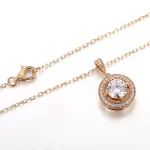
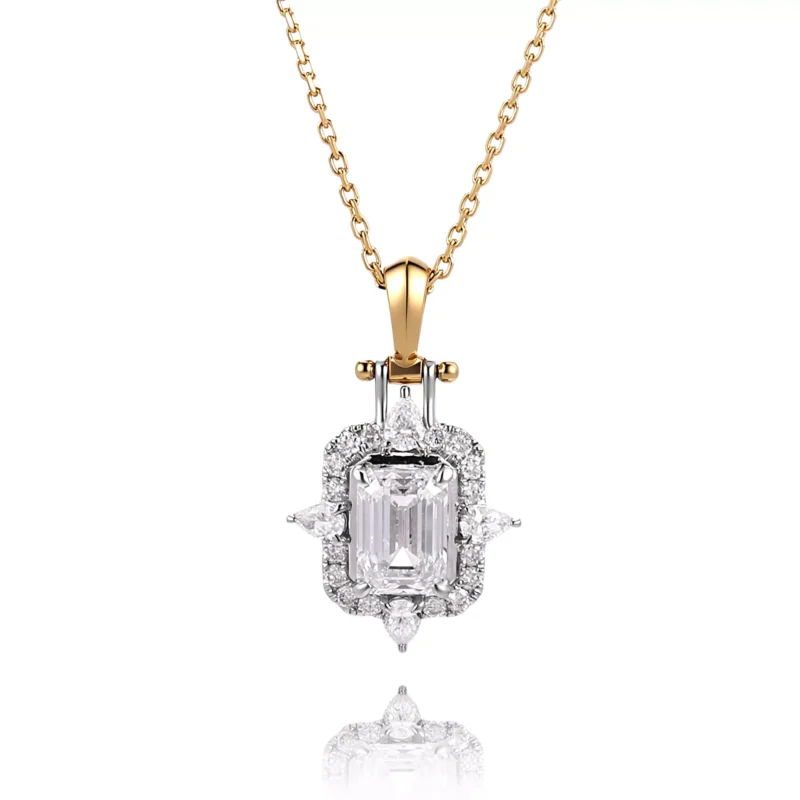
Los Angeles, early June. I was sitting at a rooftop bar in West Hollywood, the kind with string lights and a view of the hills that costs you $18 for a cocktail you pretend to enjoy. Across from me, Nora was twisting a chain around her fingers — thin silver, with a single shimmering stone catching the last of the sunset.
“Three months ago, I wouldn’t have been caught dead in this,” she said, holding it up. “I would’ve called it a ‘diamond dupe’ and rolled my eyes.”
She clipped it around her neck. The moissanite pendant settled just above her collarbone, throwing tiny rainbows across the table every time she moved.
“So what changed?” I asked.
She laughed. “I stopped caring about what a stone is supposed to mean. And started caring about what it actually does.”
The Shift That Nobody Saw Coming
For years, the conversation around moissanite was painfully one-note: is it a good diamond substitute? The question itself was a trap — it assumed diamond was the standard, the default, the thing everything else had to measure up against.
But something interesting happened in 2026. The global moissanite market, valued at US$43.3 million in 2024, is projected to hit US$57.3 million by 2030, growing at 4.8% annually . North America alone accounted for $11.8 million in 2024, with millennials and Gen Z driving the demand .
The numbers tell one story. But the reasons behind them tell another.
Younger buyers aren’t choosing moissanite because it looks like a diamond. They’re choosing it because it looks like itself . The fashion world has caught on: Saint Laurent, Givenchy, Valentino, and Simone Rocha all turned their backs on traditional diamonds in their spring-summer 2026 runways, showing rainbow-colored crystals and alternative stones instead . Vogue called moissanite and enamel the “ultimate summer layering pieces” in a recent feature on Dorsey’s new capsule collection .
The shift is from status symbol to self-expression. And that’s where moissanite finally gets to be the protagonist of its own story.
The Ring That Started a Conversation
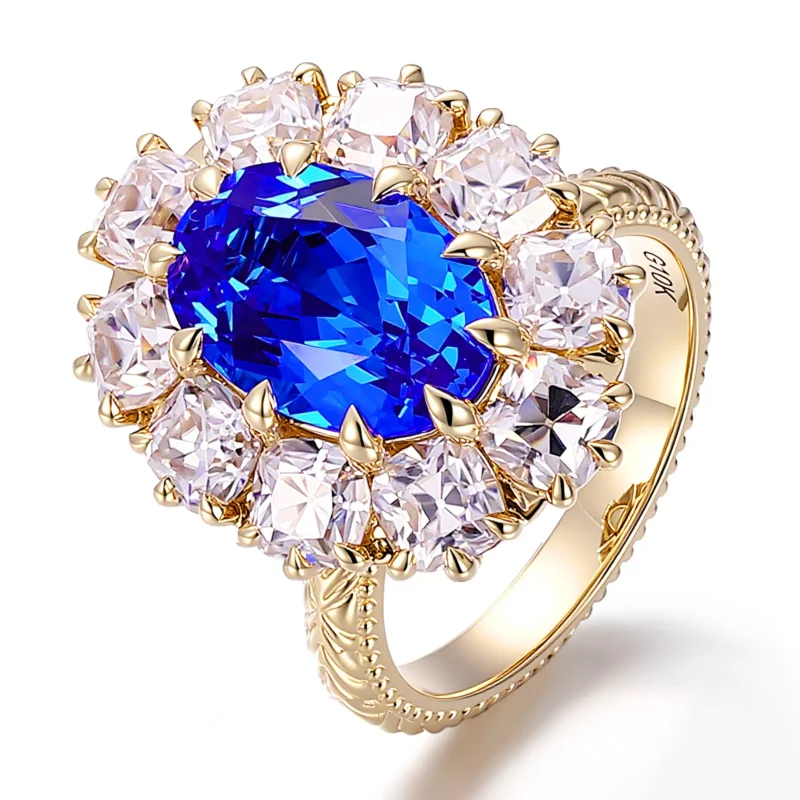
Back to Nora. She wasn’t wearing just a necklace. On her left ring finger sat a ring I hadn’t noticed until she reached for her drink — a nature-inspired setting with a single moissanite center stone, surrounded by what looked like tiny twigs wrapping around the band.
“This is the part that gets people,” she said, rotating it under the bar lights. “I didn’t want a diamond. I didn’t want a lab diamond either. I wanted this.”
She’d found it through a brand called Eclara Jewelry, which launched a nature-inspired engagement ring collection in May 2026 aimed at couples who prioritize “meaning over tradition” . The collection features moss agate, green sapphire, alexandrite, and moissanite — stones chosen for their symbolism and individuality rather than their carat weight or price tag .
“I went to three different jewelry stores in LA,” Nora said. “Every single salesperson tried to sell me a diamond. One of them literally said, ‘But won’t your friends think it’s fake?'”
She paused. “I told him, ‘My friends know I don’t give a damn what they think.'”
The Real Question Isn’t “Is It Real?”
Here’s the thing about moissanite that most people miss: it’s not pretending to be anything. It’s a lab-created silicon carbide gemstone with a refractive index of 2.65 — higher than a diamond’s 2.42 . It has more fire, more rainbow sparkle, and at Mohs 9.25 hardness, it’s durable enough to survive daily wear .
It was first discovered in a meteor crater in Arizona by French scientist Henri Moissan in 1893 . A stone from the stars. Something that literally fell out of the sky.
And yet, the cultural baggage around “alternatives” has kept it in the shadow of mined diamonds for decades. That’s finally changing, and it’s changing because of a generation that refuses to accept inherited definitions of value.
“People ask me if I’m worried about resale value,” Nora said, swirling her drink. “I tell them — if I ever need to sell my engagement ring to pay bills, the relationship has bigger problems than the stone’s secondary market.”
Jewelry industry observers have noted that younger American couples are shifting away from status-driven luxury and toward authenticity, emotional value, and long-term personal connection . Eclara’s founder, Kate Williams, put it this way: “We’re seeing more couples searching for rings that truly feel personal instead of choosing from the same traditional styles everyone else has” .
The Runway to Reality Pipeline
Moissanite’s rise isn’t just about engagement rings. It’s showing up everywhere — in minimalist men’s jewelry, in high-fashion runway collections, in the kind of everyday pieces that used to be reserved for diamonds .
DC Fashion Week’s 2026 coverage highlighted a major shift: jewelry is no longer a “secondary embellishment” but a “defining punctuation mark of modern power dressing” . Designers are prioritizing materials with optical properties that maximize visual impact under runway lighting, and moissanite’s extraordinary fire makes it a natural choice .
The trend report notes that “heavy gemstones often distort the clean lines of delicate textiles,” while moissanite’s lightweight durability allows designers to experiment with dramatic cuts without compromising garment drape . In other words: the stone doesn’t compete with the clothing — it completes it.
This is a massive departure from the traditional jewelry paradigm, which prized weight and bulk over optical performance. The 2026 runway standard? “Fluid dynamics, structural minimalism, and maximum fire” .
How a Stone from a Meteor Became a Statement
Nora finished her drink and leaned back. The pendant caught the bar lights and scattered them across her neck, tiny prisms dancing in the evening air.
“I remember the first time I saw a moissanite ring in person,” she said. “My cousin’s. She got engaged in 2022. I thought, ‘Oh, that’s pretty, but it’s not a real diamond.'”
She laughed at herself.
“God, I was such a snob. I was judging her love based on the certificate that came with a rock.”
That’s the cultural shift happening right now — not just in jewelry, but in how we think about what matters. The wedding industry has spent generations telling us that a diamond ring is proof of commitment. But that’s marketing, not truth. De Beers didn’t invent love. They invented a campaign that made us all feel like we were failing if we didn’t spend three months’ salary on a piece of carbon.
“The ring my grandmother got was from a Sears catalog,” Nora said. “She wore it for fifty-two years. My grandfather never apologized for it. And nobody ever asked her if she was disappointed.”
She looked down at her hand. The nature-inspired setting caught the light, the twig-like details throwing shadows across her skin.
“This ring means I got to choose. Not the industry. Not my mother. Not what I thought I should want. Me. The stone came from a meteor. The design came from a woman who wanted rings to feel like they belonged to the person wearing them . And the person wearing it is someone who finally stopped apologizing for wanting something different.”
What Makes It Stick
The numbers back up what Nora and people like her are feeling. China’s moissanite market is growing at 8.8% CAGR to reach $12 million by 2030 . Online platforms and independent jewelers are spreading awareness by offering moissanite in varied price ranges and styles, making it accessible to a global audience .
Men’s jewelry is another fast-growing segment — minimalist moissanite rings, bracelets, and chains retailing for $79 to $299, designed for daily wear rather than special occasions . It’s not about replacing diamonds anymore. It’s about expanding what jewelry can be.
The technology behind moissanite production has also improved dramatically. Controlled lab environments produce near-colorless stones with high clarity, enabling customization in cuts, colors, and sizes that natural stones can’t match . CAD tools and rapid prototyping mean custom pieces can be developed more efficiently than ever .
But none of that would matter if the cultural conversation hadn’t shifted. And it has — from “is it real?” to “does it feel like you?”
The Last Word
Nora and I walked out of the bar at around ten. The LA night was warm, the kind of evening that makes you forget you live in a city of freeways and strip malls. She was still wearing the necklace, the pendant catching streetlights as she walked.
“You know what the funniest part is?” she said. “My mom finally saw the ring on FaceTime last week. She stared at it for like ten seconds. I was so ready for the sigh, you know? The disappointment.”
“What happened?”
“She said, ‘That’s not a diamond, is it?’ I said no. She went quiet again. Then she said, ‘Well, it’s prettier than mine was.'”
Nora laughed.
“My dad bought her ring at a department store in 1989. She never told me that until I showed her mine. She spent thirty-five years feeling like her ring wasn’t enough. And now she’s telling me mine is better.”
She stopped walking and turned to face me. The moissanite on her finger and around her neck were both catching the glow of a streetlamp, throwing tiny rainbows onto the sidewalk.
“The thing about a stone from a meteor is that nobody can tell you it doesn’t belong here. It’s from space. It’s been here longer than we have. And if I want to wear one on my hand for the rest of my life, that’s my story to tell. Not De Beers’s.”
She started walking again, and I followed.
“I’m not sorry it’s not a diamond. And I’m done pretending I ever should be.”
Afterword: Nora and her fiancé, a graphic designer she met at a mutual friend’s dinner party, are getting married next spring in Joshua Tree. She’s already designing a custom wedding band to stack with the nature-inspired ring — a “Toi et Moi” style with two moissanite stones representing their two different hometowns . Her mother has offered to contribute to the wedding dress. The sigh, it turns out, was never really about the ring.